
Most small firms in India run on thin margins and thinner teams. The visible parts of the business get all the attention: the storefront, the invoices, the WhatsApp replies. The quieter layer underneath, the software plumbing that decides how fast an order moves or how a payment reconciles, is where the real efficiency gains sit today. Six technologies in particular have quietly reshaped how a ten-person shop competes with a two-hundred-person one.
Six Quiet Engines Powering Lean Operations
None of these tools are new in the enterprise world. What changed over the last three years is pricing, packaging and the arrival of usable Hindi and regional-language interfaces. A kirana chain in Pune or a boutique exporter in Tiruppur can now buy the same class of infrastructure that a Bengaluru unicorn runs on, billed per user and switched on in an afternoon.
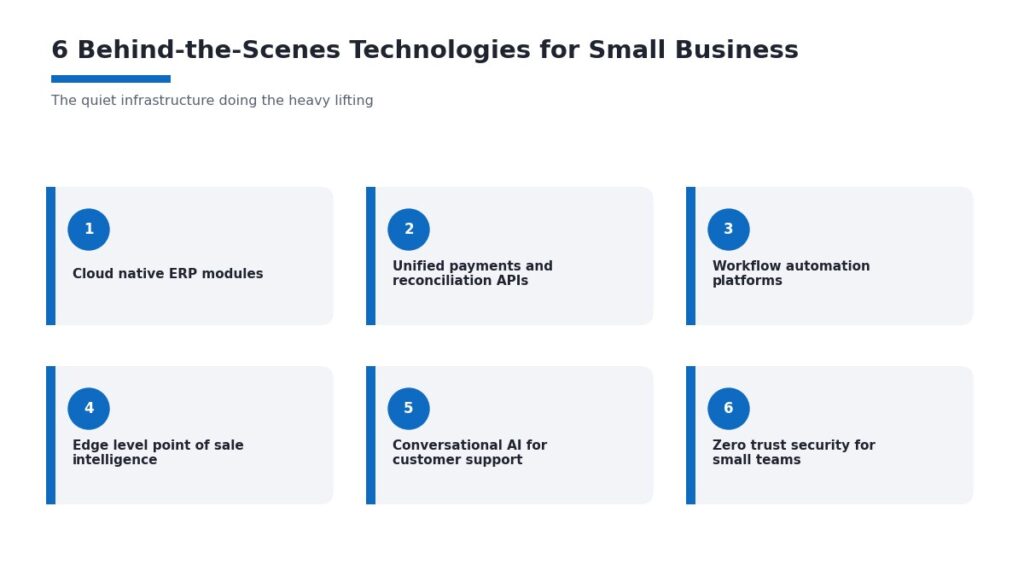
1. Cloud Native ERP Modules
The old ERP install lasted six months and cost a car. Modular cloud ERPs now let a small business turn on only what it needs: inventory, GST invoicing, payroll. Data lives in one place, so the accountant, the warehouse and the founder look at the same number. The saving is not the licence fee, it is the elimination of the weekly reconciliation meeting.
2. Unified Payments and Reconciliation APIs
UPI moved consumer payments; the quieter revolution is the reconciliation layer sitting behind it. APIs from payment aggregators push settled transactions straight into the accounting ledger with the counterparty, the tax split and the settlement date already attached. A furniture reseller who used to spend Saturday matching bank statements now spends it on catalogue photography.
3. Workflow Automation Platforms
Tools that connect a form, a spreadsheet, an email and a CRM without code have removed a whole category of repetitive work. A new lead on the website becomes a WhatsApp message to the sales lead, a row in the pipeline sheet and a follow-up reminder three days later, all without a human touching it. The people who used to copy-paste now qualify leads.
4. Edge Level Point of Sale Intelligence
Modern POS terminals do more than accept cards. They forecast which SKUs will run out on Friday, flag returns that look suspicious and print a GST-compliant bill in the local language. Because the compute happens on the device, a two-bar network is enough. For a grocery in a Tier 3 town, that reliability matters more than any dashboard.
5. Conversational AI For Customer Support
A well-tuned chatbot handles the ninety percent of queries that are repetitive: order status, return policy, store timings. The remaining ten percent, where a human actually adds value, reaches a person faster because the queue is shorter. Regional-language models have made this viable for businesses serving customers who do not type in English.
6. Zero Trust Security For Small Teams
Ransomware does not skip small firms; it targets them because defences are thinner. Zero trust access, where every request is verified regardless of network, used to require a security engineer. Packaged versions now ship as a browser extension and a mobile app, priced within reach of a fifteen-person company. One weekend of setup replaces a permanent worry.
Where Integration Actually Breaks
Tools often work well alone but fail when connected. A brief integration audit before purchase can prevent months of rework.
The same cloud and event-driven systems used by SMB software also support platforms featuring titles such as jili fortune gems 2. The technology is common; clean integration is the real advantage. Users should also check local regulations.
Before signing, ask:
- Is there a documented API?
- Does it connect to your accounting system?
- Can data be exported?
- Who owns and stores the data?
Data residency affects compliance, while W3C standards can indicate better portability.
Measuring the Return Without Fooling Yourself
Efficiency projects often look successful in presentations but barely affect profit. The problem is measuring activity instead of outcomes: hours saved matters less than orders shipped per staff-day.
Avoid tracking adoption alone, using unrealistic baselines, ignoring human oversight and switching costs, or crediting all revenue growth to one tool.
Choose two or three financial metrics, such as inventory turns, days sales outstanding, or gross margin per employee. If they do not improve within two quarters, the tool or its setup is not working.