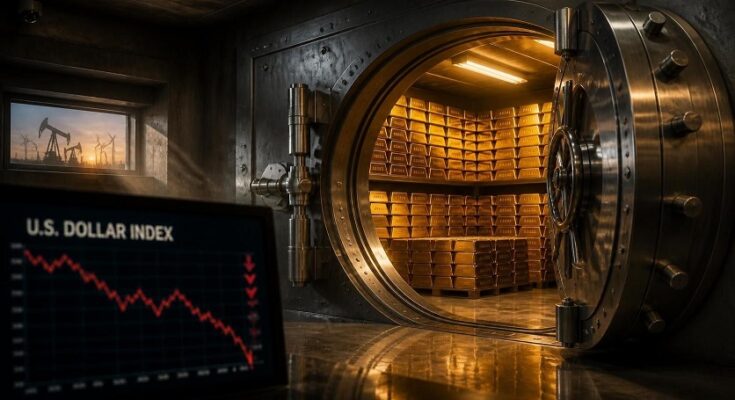
The postwar monetary order established under U.S. hegemony is undergoing structural decomposition. This analysis synthesizes four interrelated dynamics—geopolitical conflict cycles, gold reserve accumulation, demand-side coordination mechanisms, and energy transition trajectories—into a unified framework for understanding the erosion of dollar-based settlement infrastructure. The argument proceeds from empirical observation rather than ideological assertion: the petrodollar system’s maintenance requirements are increasingly incompatible with emerging economic and technological realities.
1. The Conflict-Gold-Dollar Nexus: A Mechanism Under Stress
1.1 Theoretical Framework
The petrodollar architecture operates through a self-reinforcing loop: dollar-denominated oil pricing creates structural demand for Federal Reserve liabilities; this demand enables deficit financing without immediate currency depreciation; the resulting monetary flexibility supports military expenditure that, in turn, preserves the geopolitical conditions necessary for dollar denominated energy markets.
This system requires active maintenance. Alternative reserve assets—particularly those with fixed supply schedules—pose existential threats to the seigniorage benefits accruing to the issuer of the global reserve currency.
1.2 The Suppression Mechanism
When supply-side disruptions occur in energy-producing regions, the following sequence typically unfolds:
| Phase | Market Response | Policy Response | Asset Price Effect |
|---|---|---|---|
| Disruption | Oil price spike | Inflation concerns | Gold initially rises |
| Rate expectations | Fed tightening signals | Higher real rates | Gold suppressed |
| Dollar demand | Energy importers acquire USD | USD appreciation | Gold denominated in USD falls |
| Net result | Gold underperforms | Dollar maintains premium | Alternative suppressed |
1.3 Empirical Evidence
The 2025 Middle East escalation provides a representative case study:
Oil price movement: $71.23 → $111.54 per barrel (+56.6%)
Gold price movement: $5,294.40 → $4,651.50 per ounce (−12.1%)
This inverse correlation exceeds what standard commodity market dynamics would predict. The magnitude suggests policy-coordinated suppression rather than organic market clearing.
1.4 Distributional Consequences
Beneficiary analysis:
- U.S. shale producers: windfall margins during price spikes
- Federal government: increased structural dollar demand
- Defense sector: sustained procurement justification
Cost-bearing analysis:
- Non-oil-producing developing economies: terms-of-trade deterioration
- Energy-importing nations: reserve depletion and currency depreciation
- Global south: imported inflation and austerity conditionality
The mechanism functions as an extraction system, not merely an inequitable one.
2. The Gold Constraint: Structural Asymmetries in Monetary Power
2.1 The Fundamental Vulnerability
The dollar system’s sustainability depends on the continued suppression of gold. This suppression faces an insurmountable constraint: the United States cannot manufacture gold.
This creates a trilemma from which no exit exists without systemic disruption.
2.2 Option Space Analysis
Option A: Monetary expansion to acquire gold
- Mechanism: Federal Reserve creates reserves → purchases gold → gold price rises
- Consequence: Accelerated dollar depreciation, loss of confidence
- Outcome: Self-defeating; exposes fiat architecture
Option B: Reserve liquidation to suppress price
- Mechanism: U.S. Treasury sells gold holdings → increases supply → price declines
- Consequence: Signal of desperation; strategic reserve depletion
- Outcome: Catastrophic signaling effect; empire liquidating crown jewels
Option C: Strategic inaction (current policy)
- Mechanism: Maintain existing posture; allow market forces to operate
- Consequence: Continued erosion of relative position
- Outcome: Slow-motion failure
2.3 Reserve Accumulation Data
Central bank behavior reveals strategic positioning:
| Metric | 2022-2025 Average | Historical Precedent |
|---|---|---|
| Annual gold purchases | ~1,000 tonnes | ~500 tonnes (2010-2021) |
| Q2 2026 net purchases | 244 tonnes | — |
| Central banks holding gold | 93% | 81% (2025) |
| Planning to increase holdings | 45% | — |
| Expecting USD share decline | 74% | — |
Composition shift:
- Gold: 27% of global official reserves
- U.S. Treasuries: 22% of global official reserves
- Crossover point: first time in 30 years
2.4 The Gold Logic
Gold’s monetary properties derive from physical constraints:
- Supply inelasticity: Annual production ~3,500 tonnes; stock above ground ~200,000 tonnes
- No counterparty risk: Settlement finality without institutional mediation
- Sanctions immunity: Physical possession cannot be frozen remotely
- Temporal stability: Purchasing power preservation across centuries
- No default mechanism: Unlike debt instruments
The Greenspan observation remains operative: gold standard incompatibility with welfare-state expenditure patterns is precisely why gold-backed settlement threatens current arrangements.
3. Demand-Side Coordination: The OPIC Framework
3.1 Theoretical Innovation
Previous de-dollarization efforts have failed due to supply-side focus. Producer coordination (OPEC) can restrict supply but cannot dictate settlement currency. Currency diversification by sovereigns (Russia, China) reduces exposure but does not alter market structure.
The missing element: organized consumer coordination.
3.2 OPIC Architecture
The Organization of Petroleum Importing Countries would aggregate demand-side power through three mechanisms:
Channel 1: Price discipline
- Establish maximum acceptable price threshold
- Collective strategic reserve release during manipulation events
- Coordinated purchasing from non-disrupting sources
- Accelerated alternative development
Channel 2: Settlement diversity
- Bilateral currency swap arrangements
- Basket settlement mechanisms
- Gold-backed instrument development
- Progressive reduction of dollar intermediation
Channel 3: Demand reduction
- Renewable energy mandates
- Electric vehicle requirements
- Efficiency standard harmonization
- Technology sharing protocols
3.3 BRICS Complementary Infrastructure
| Institution | Function | Dollar System Equivalent |
|---|---|---|
| New Development Bank | Multilateral lending | World Bank |
| Contingent Reserve Arrangement | Liquidity support | Fed swap lines |
| BRICS Payment System | Cross-border settlement | SWIFT |
| “Unit” instrument | Gold-backed settlement | Special Drawing Rights |
3.4 Current Adoption Metrics
| Indicator | Value | Implication |
|---|---|---|
| Non-dollar oil settlement share | ~20% | Critical mass emerging |
| Saudi Aramco-China yuan settlement | ~45% | Bilateral bypass operational |
| UAE OPEC exit (May 2026) | Complete | Pricing flexibility achieved |
The network effects that historically reinforced dollar dominance now operate in reverse as adoption thresholds are crossed.
4. Energy Transition: Structural Demand Destruction
4.1 The Petrodollar-Energy Nexus
The petrodollar system’s foundation is global oil dependence. Reduced oil demand directly erodes dollar demand. This creates a strategic incentive for importers to accelerate transition—not merely for environmental reasons but for monetary sovereignty.
The equation:
Post-carbon economy = Post-petrodollar economy
4.2 OPIC Renewable Acceleration Framework
| Initiative | Mechanism | Dollar Impact |
|---|---|---|
| Solar/wind investment | Capacity expansion | Reduced oil demand |
| Battery storage | Grid stability | Reduced peaking demand |
| EV mandates | Transport electrification | Permanent demand destruction |
| Cross-border grids | Energy sovereignty | Reduced strategic vulnerability |
| IP sharing | Accelerated adoption | Compressed timeline |
Manufacturing concentration: China produces approximately 80% of global solar panel output.
4.3 Demand Projections
International Energy Agency baseline projections indicate global oil demand plateau by early 2030s. OPIC-coordinated acceleration could advance this timeline by 5-7 years.
Cumulative effect: Each barrel not consumed represents a dollar not demanded. Each renewable megawatt installed represents permanent petrodollar erosion.
5. Synthesis: The Decomposition Timeline
5.1 Causal Chain
text
Conflict exposure → Gold accumulation → Demand coordination → Energy transition
        ↓                    ↓                    ↓                    ↓
   Suppression              Structural           Settlement           Demand
   mechanism               asymmetry            bypass               destruction
   revealed                 exploited            operationalized      accelerated
        ↓                    ↓                    ↓                    ↓
        └────────────────────┴────────────────────┴────────────────────┘
                                      ↓
                         Dollar system decomposition
5.2 Indicators of Transition
| Domain | Metric | Status |
|---|---|---|
| Reserve composition | Gold vs. Treasuries | Crossover achieved |
| Settlement infrastructure | Non-dollar share | ~20% and rising |
| Central bank behavior | Accumulation rate | 2x historical |
| Producer flexibility | OPEC cohesion | Fracturing |
| Energy trajectory | Demand plateau | Projected early 2030s |
5.3 The Dollar Paradox
The United States faces an irresolvable contradiction:
- Requirement: Strong dollar to maintain reserve status
- Reality: Fiscal policy and geopolitical action undermine strength
- Constraint: Cannot print gold; cannot control gold price; cannot weaponize gold without self-harm
6. Conclusion: Structural inevitability
The dollar-based settlement system is not collapsing through discrete event but through cumulative structural pressure. The four dynamics analyzed—conflict cycle exposure, gold’s physical constraints, demand-side coordination, and energy transition—are mutually reinforcing.
The gold standard’s “disciplinarian” function—its inability to be printed, manipulated, or weaponized without consequence—is precisely what makes it threatening to current arrangements and attractive to sovereign actors seeking monetary independence.
The transition trajectory is clear:
- Gold re-emerges as neutral settlement asset
- Regional settlement mechanisms proliferate
- Energy transition reduces petrodollar demand
- Multipolar monetary order consolidates
Nations failing to diversify reserves and adapt to emerging settlement infrastructure face vulnerability to U.S. monetary policy externalities and geopolitical coercion.
The petrodollar era is terminating. The architecture of what follows is under construction.