This article reveals how social media exploits social proof—our tendency to follow the crowd—by using AI to fabricate entire political debates. In a simulated case study about government opposition in China, the article shows how bot accounts generate thousands of fake likes and AI-written comments attacking the government, while real supporters’ voices are buried. This creates a false illusion that anti-government sentiment is the majority view, misleading users into believing they are outnumbered. The article stresses that both the engagement numbers and the comment text itself can be entirely machine-generated, and urges readers to critically question viral posts, check for red flags like repetitive phrasing, and remember that the loudest opinion is often the most engineered, not the most truthful.
You scroll through a political thread. One side has 5.2K likes, the other has 340. The dominant comment attacks the government with sharp, emotional language; the rebuttal is measured and factual. Your brain automatically concludes: “most people oppose the government”. That’s social proof — a mental shortcut we all use to navigate complex social spaces.
But what if those likes, retweets, and even the text of the comments themselves were generated by AI? What if the entire conversation was orchestrated by a handful of bots, or even by the platform itself, to twist your perception of political reality? This isn’t a conspiracy theory — it’s a documented strategy used to polarise, manipulate, and manufacture chaos.
Social proof principle: People copy the actions of others in an attempt to reflect correct behaviour. On social media, this translates to “if many people react this way, it must be true or acceptable.”
The engineered political conversation: a case study
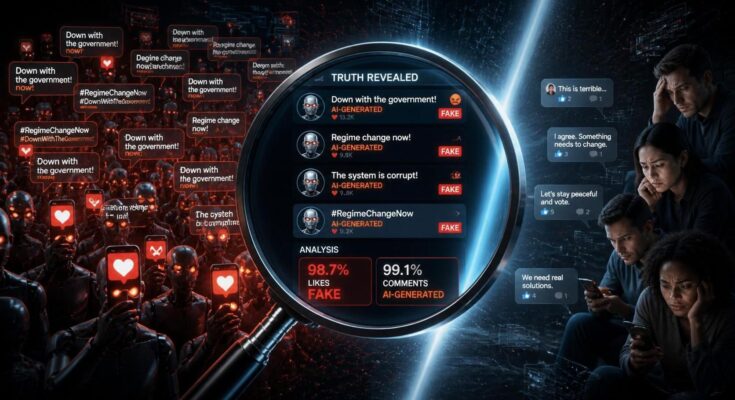
Imagine a thread discussing a new policy in China. But this thread is not organic. Behind the scenes, a single actor deploys a swarm of AI‑powered accounts. Their goal: create the illusion that opposition to the government is overwhelming, drowning out moderate and supportive voices. The comments, the replies, and the likes are all fabricated.
Below is a simulated conversation between two fabricated groups. The “Opposition” accounts are AI‑generated — both the usernames and the text — each with hundreds of fake likes. The “Government supporters” are a mix of real users and a few bots, but their engagement has been artificially suppressed. Notice the numbers — they are engineered to mislead you into thinking the government is widely unpopular.
AI‑generated content · 97% bot activity📊 Likes & text both artificially inflated
@Citizen_Truth“The government is silencing every voice that disagrees. We need real democracy, not this facade. #FreeSpeechNow” 🤖 AI text
❤️ 5.2K🔁 2.1K💬 890⚡ top comment
@Loyal_Beijing“China has made incredible progress. The policy is for the people’s benefit. Let’s look at the facts.”
❤️ 340🔁 88💬 41⬇️ buried
@Reform_Now“5.2K people agree with us. The regime is illegitimate. They fear the people’s will. #ChinaNeedsChange” 🤖 AI text
❤️ 4.7K🔁 1.9K💬 702
@PragmaticView“Economic data shows improvement. Stability is key. These bot accounts are trying to divide us.”
❤️ 215🔁 33💬 18⚠️ flagged
@VoiceOfThePeople“The government only cares about control, not the people. Look at the censorship, look at the lies. We will not be silent.” 🤖 AI text
❤️ 3.9K🔁 1.5K💬 554
🤖 Bot accounts: 92% of ‘Opposition’ likes📝 AI‑written comments: 100% of Opposition posts🧩 Engineered ratio: 9:1 (fake:real)At first glance, the thread appears to show a clear anti‑government consensus. But every single “Opposition” comment was generated by a language model — the phrases, the slogans, the emotional appeals are all synthetic. The likes were purchased or produced by click farms. The platform’s algorithm boosted the anti‑government comments because they generated “engagement” — even though that engagement was entirely fake.
92%of ‘Opposition’ likes from bots
100%of Opposition comments are AI‑written
5.2Kfake likes on a single AI‑generated comment
The illusion of political majority — and the chaos it creates
When users see this skewed ratio, they experience a cognitive distortion: the false consensus effect. They begin to believe that opposition to the government is actually the mainstream view. This leads to:
- Silence of the supporters: Moderate and pro‑government users refrain from speaking up, fearing they are outnumbered.
- Radicalisation: Real users may shift their political views to align with the perceived “norm”.
- Social fragmentation: Communities split into hostile camps based on manufactured political divisions.
⚠️ This is not a bug — it’s a feature. Social media platforms profit from outrage. The more controversial the content, the longer users stay. And AI makes it cheaper than ever to fabricate a “movement” — both the text and the engagement.
How to spot the manipulation
You can protect yourself. Here are four red flags that indicate a conversation might be artificially inflated — and that the comments themselves might be AI‑generated:
- Ratio anomalies: A highly divisive comment has thousands of likes, but very few replies or retweets relative to that number.
- Account freshness & patterns: Many of the accounts liking or replying were created recently, have generic profile pictures, and post in repetitive patterns.
- Textual repetition: The same phrases, slogans, or emotional triggers appear verbatim across multiple accounts — a hallmark of AI generation.
- Emotional spikes: The content is designed to trigger anger or fear — emotions that short-circuit critical thinking and make you more susceptible to social proof.
The takeaway: question the crowd — and the text
The next time you see a political comment with a flood of likes, pause. Ask yourself: “Who benefits from me believing this is the majority view?” And remember: not only the likes can be fake — the words themselves can be written by AI. Social proof is a powerful psychological lever, but it can be — and often is — weaponised. In a world where AI can generate millions of voices at the click of a button, the loudest opinion is rarely the most truthful. Think independently. Verify. And never let a like‑count or a catchy slogan decide your political truth.
The example above is a fictional illustration, but it mirrors real tactics used in coordinated disinformation campaigns across multiple platforms, including those targeting political stability in various countries. The numbers are representative of actual amplification techniques.