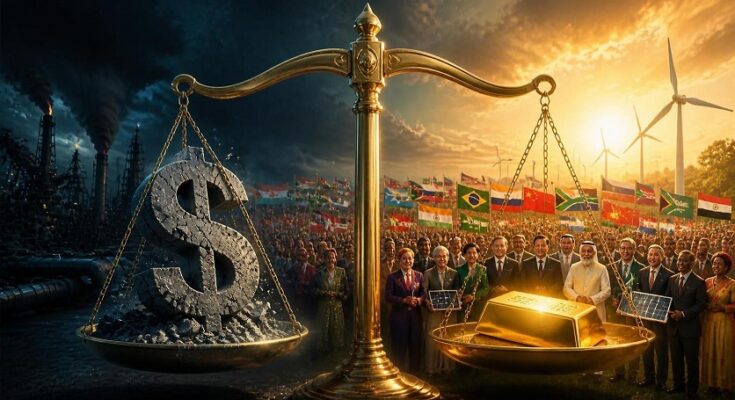
For over half a century, the United States has enjoyed what economists euphemistically call an “exorbitant privilege”—the ability to print the world’s primary reserve currency and force other nations to absorb the consequences. This privilege was never earned through superior productivity or sound monetary policy. It was built on a foundation of oil, war, and manufactured crisis. The petrodollar system, established in 1974 when Saudi Arabia agreed to price oil exclusively in U.S. dollars in exchange for American security guarantees, created a permanent global demand for greenbacks that had nothing to do with the underlying strength of the American economy.
But the architecture of this system is now visible to all. The evidence is overwhelming: Middle East conflicts are not merely geopolitical crises—they are staged financial operations designed to spike oil prices, drain dollar liquidity from rivals, suppress gold, and force nations to hold dollars rather than accumulate sound assets. The Ukraine conflict severed Europe’s reliance on cheap Russian gas, forcing it to replace it with more expensive American LNG. Disruptions at the Bab-el-Mandeb and the Strait of Hormuz have tightened global supplies and surged energy prices, benefiting American producers while economically squeezing both rivals and allies.
This system is not merely unjust. It is unsustainable. And two emerging forces—BRICS and OPIC—are poised to dismantle it together.
The Two Pillars of the Coming Financial Revolution
BRICS represents the supply side of the new financial architecture. The bloc, which now represents nearly 48% of the global population, has moved from rhetoric to infrastructure. It has launched a working prototype of a gold-backed trade currency called “The Unit”—a digital trading instrument backed by a reserve basket containing 40% physical gold and 60% BRICS national currencies. The pilot project, initiated in late 2025, represents a direct step toward de-dollarization. BRICS nations control a majority of global gold production and hold massive reserves, positioning gold as a neutral “settlement asset” that holds no geopolitical allegiance.
OPIC—the Organization of the Petroleum Importing Countries—represents the demand side. Modeled on OPEC but representing the consumers of oil rather than the producers, OPIC would unite the world’s largest energy importers—China, India, Japan, South Korea, Germany, France, Brazil, South Africa, and dozens of others—in a collective bargaining mechanism designed to break the war-price cycle that has enriched the American energy sector and impoverished the rest of the world.
Separately, each represents a significant threat to dollar hegemony. Together, they represent an existential challenge to the entire petrodollar system.
How the War-Based Dollar System Actually Works
To understand why BRICS and OPIC together are so powerful, one must first understand the mechanism they are attacking. The war-based dollar system operates through a predictable, repeating cycle:
Step 1: Staged Conflict. A crisis is engineered or exploited in a critical oil-producing region—the Strait of Hormuz, the Bab-el-Mandeb, the Persian Gulf. The conflict need not be entirely fabricated; it need only be amplified, prolonged, or selectively escalated at the right moment.
Step 2: Oil Price Spike. Supply disruption fears grip traders. Oil prices surge—as documented in recent ICDST reporting, from $71.23 to $111.54 per barrel, an increase of approximately 57%.
Step 3: Inflation Export. Rising oil prices reignite inflation concerns globally. Because oil is priced in dollars, every nation must purchase dollars to pay for energy. The Federal Reserve can expand the money supply at will, and the resulting inflation is not contained within U.S. borders—it is exported to every nation that must buy oil.
Step 4: Gold Suppression. Inflation fears fuel expectations that central banks—particularly the U.S. Federal Reserve—will maintain elevated interest rates. Higher rates make non-yielding assets like gold less attractive, artificially suppressing its price. As oil surged from $71 to $111, gold fell from $5,294.40 to $4,651.50 per ounce during the same period.
Step 5: Dollar Strengthening. As global demand for dollars spikes to pay for expensive oil, the dollar strengthens. Nations are forced to hold dollars rather than accumulate gold. The “exorbitant privilege” is preserved.
Step 6: American Benefit. U.S. LNG exports surge. American producers enjoy a windfall. Rivals and allies alike are economically squeezed. The military-industrial complex profits. The cycle resets.
This is not a conspiracy theory. It is a documented pattern, repeated across decades and continents. It is the architecture of dollar hegemony—a system built not on productivity or innovation, but on the deliberate manipulation of energy markets and the perpetual threat of war.
How BRICS and OPIC Together Break the Cycle
BRICS and OPIC, working in concert, can break this cycle at every link. Here is how.
1. OPIC Caps Prices; BRICS Provides Alternative Settlement
The first link in the war-price cycle is the oil price spike. OPIC would break it by refusing to buy at high prices. If the world’s largest oil importers collectively agreed to cap their purchase prices and coordinate purchases from non-conflict sources, release strategic reserves, and accelerate the transition to alternatives, the entire war-price mechanism would collapse. Oil producers would be forced to either accept lower prices or watch their revenue evaporate.
But OPIC’s price caps would be meaningless without an alternative to dollar-denominated settlement. This is where BRICS comes in. The BRICS “Unit”—backed by 40% gold and 60% member currencies—provides a neutral settlement mechanism that does not require dollars. OPIC members could purchase oil from BRICS-aligned producers using the Unit or other non-dollar mechanisms, bypassing the dollar system entirely.
The combined effect: Oil prices fall. Dollar demand falls. The inflation export mechanism breaks.
2. OPIC Drives Renewable Transition; BRICS Supplies the Technology
The second pillar of OPIC’s strategy is an accelerated transition to renewable energy. The logic is inescapable: the petrodollar system exists because the world needs oil, and oil is priced in dollars. If the world no longer needs oil—or needs dramatically less of it—the foundation of dollar hegemony crumbles.
OPIC members would collectively commit to massive investment in solar, wind, and battery storage. They would phase out internal combustion engines, build cross-border renewable energy grids, and share technology among member states.
BRICS is already positioned to supply this transition. China manufactures roughly 80% of the world’s solar panels. BRICS nations control critical mineral supply chains essential for batteries and renewable infrastructure. The New Development Bank, BRICS’ multilateral lending institution, can finance renewable energy projects across the Global South.
The combined effect: Oil demand falls. Renewable energy replaces fossil fuels. The petrodollar’s foundation erodes.
3. BRICS Provides the Gold; OPIC Demands It as Settlement
The third pillar is the restoration of gold as the anchor of the global monetary system. BRICS nations control a majority of global gold production and have been accumulating reserves at a historic rate. By the end of 2025, the total value of gold held in central bank reserves officially surpassed the value of U.S. Treasury holdings for the first time in 30 years. Gold now accounts for 27% of total official global reserves, compared to U.S. Treasuries at 22%.
OPIC members would collectively demand that oil and other commodity trades be settled in gold-backed instruments rather than dollars. They would build gold reserves, establish gold-backed settlement mechanisms, and coordinate their monetary policies to reduce dollar dependence.
The combined effect: Gold demand rises. Dollar demand falls. The “exorbitant privilege” is eliminated.
4. BRICS and OPIC Together Build Parallel Institutions
The final pillar is the construction of parallel financial institutions that can replace the dollar-based system. BRICS has already begun this work:
- The New Development Bank (NDB): A multilateral lending institution that provides an alternative to the World Bank and IMF
- The Contingent Reserve Arrangement (CRA): A liquidity mechanism that provides an alternative to Federal Reserve swap lines
- The BRICS Payment System: A cross-border payment mechanism that bypasses SWIFT
- The “Unit”: A gold-backed trade currency for intra-BRICS and BRICS-OPIC trade
OPIC would complement these institutions by:
- Establishing a Joint Strategic Petroleum Reserve: A shared reserve to stabilize prices and counter manipulation
- Creating a Renewable Energy Fund: A pooled investment vehicle for clean energy projects
- Building a Settlement Clearing House: A platform for non-dollar oil transactions
- Coordinating Gold Reserve Policies: A collective gold reserve to back member currencies
The combined effect: A complete parallel financial architecture that can function independently of the dollar system.
The Geopolitical Dividend: Ending the Wars
Perhaps the most profound consequence of a BRICS-OPIC alliance would be the end of the perpetual conflict cycle in the Middle East.
The recent analysis of Middle East conflicts reveals a disturbing pattern: staged crises are engineered to spike oil prices, drain dollar liquidity from rivals, and force nations to hold dollars rather than accumulate gold. The Ukraine conflict severed Europe’s reliance on cheap Russian gas, forcing it to replace it with more expensive American LNG—entrenching U.S. energy dominance on the continent. Disruptions at the Bab-el-Mandeb and the Strait of Hormuz have tightened global supplies and surged energy prices, benefiting American producers while economically squeezing both rivals and allies.
A BRICS-OPIC alliance that refuses to buy at high prices and aggressively transitions to renewables would remove the financial incentive for these conflicts. If wars no longer produce economic benefits for the instigators, they become strategically pointless. The military-industrial complex that profits from perpetual conflict would lose its raison d’être.
The allegory of Netanyahu as the “puppet” pushing a reluctant U.S. president into war is, as analysts note, “not only silly but also pernicious.” The reality is that the U.S. was a “willing and full partner” in these conflicts, driven by its own strategic motives. BRICS and OPIC would remove those motives by making war economically counterproductive.
The Inevitable Backlash—and Why It Will Fail
The United States and its allies will undoubtedly resist the BRICS-OPIC alliance. They will use every tool at their disposal: diplomatic pressure, economic sanctions, military threats, and propaganda campaigns. They will accuse BRICS and OPIC members of “aggression” and “undermining the global order.”
But these efforts will fail for a simple reason: the world is no longer willing to be held hostage.
The evidence is already overwhelming. Central banks are accumulating gold at a historic rate. Alternative payment systems are emerging. The BRICS “Unit” is operational. The petrodollar system is being dismantled piece by piece, and the BRICS-OPIC alliance would be the final blow.
The United States is caught in a classic financial paradox: it needs the dollar to be strong to maintain its status, but its fiscal policies and geopolitical actions continuously undermine that strength. It cannot print gold. It cannot dump its gold reserves without signaling desperation. It cannot buy gold without destroying the dollar. Its primary financial superpower advantage—the printing press—is its greatest weakness in a world shifting back toward sound, unprintable assets.
As Alan Greenspan himself noted, a gold standard is “not possible in a welfare state” because it would restrict the ability to run large deficits and wage expensive wars. This is precisely why the shift to gold-backed settlement systems is so threatening to the current order—and why a BRICS-OPIC alliance would be so effective.
A Multipolar World Built on Gold, Renewables, and Sovereignty
The BRICS-OPIC alliance would accelerate the transition to a multipolar world where no single nation can dominate the global financial system. In this new world:
- Gold sits at the center of nearly all emerging monetary systems, providing a neutral, non-sovereign store of value
- Renewable energy powers economies that cannot be blockaded or held hostage
- Trade is conducted in a basket of currencies and gold-backed settlement assets
- Wars of economic coercion become strategically pointless
- Sovereignty is restored to nations that have long been subject to the whims of U.S. monetary policy
The shift toward gold is not a call to return to a classical “Gold Standard” with fixed price parities, but rather a move toward gold-backed settlement systems that provide stability and neutrality in a fragmenting world. By controlling a majority of global gold production and holding massive reserves, BRICS nations are already positioning gold as a “settlement asset” that holds no geopolitical allegiance. OPIC would complete this transition by attacking the demand side of the petrodollar equation.
The Road Ahead: A Blueprint for Action
For the BRICS-OPIC alliance to succeed, it must move from concept to concrete action. Here is a proposed roadmap:
Phase 1 (Year 1): Formalization
- OPIC formally constituted with founding members including China, India, Japan, South Korea, Germany, France, Brazil, South Africa, and Indonesia
- BRICS-OPIC Joint Declaration on Monetary Cooperation
- Establishment of working groups on settlement mechanisms, renewable energy, and gold reserves
Phase 2 (Years 2-3): Institutional Building
- Launch of the BRICS-OPIC Settlement Clearing House
- Establishment of the Joint Strategic Petroleum Reserve
- Creation of the Renewable Energy Fund
- Pilot programs for gold-backed oil settlement
Phase 3 (Years 4-5): Implementation
- Majority of BRICS-OPIC oil trade settled in non-dollar currencies
- Significant reduction in oil demand through renewable transition
- Coordinated gold reserve accumulation
- Expansion of OPIC membership to include additional oil importers
Phase 4 (Years 5-10): Consolidation
- Dollar’s share of global reserves falls below 40%
- Gold-backed settlement becomes the norm for commodity trade
- Renewable energy dominates new investment
- The war-based dollar system is structurally obsolete
Conclusion: The End of the War Economy
Gold, by contrast to the dollar, is a strict disciplinarian. It cannot be printed, manipulated, or weaponized without consequences. The world is no longer content to be held hostage by the fiscal and monetary policies of a single nation.
The current energy crisis is accelerating the transition away from fossil fuels, and a post-carbon world is inherently a post-petrodollar world. The move by major economies to buy gold, secure critical minerals, and invest in renewables represents a concerted effort to break free from the U.S.-centered financial order.
BRICS and OPIC together would formalize this effort, giving it institutional weight and collective bargaining power. They would transform scattered resistance into a coordinated offensive. They would make war economically counterproductive and peace economically profitable.
The evidence is clear: the era of the dollar’s undisputed dominance is ending. The world is preparing for a multipolar monetary reality where gold sits at the center of nearly all emerging systems. Countries that fail to diversify their reserves and adapt to this new reality risk being left vulnerable to the whims of U.S. monetary policy and geopolitical manipulation.
The transition to gold is not just a prudent hedge; it is becoming a necessary act of sovereignty. And the BRICS-OPIC alliance is the vehicle that will get us there.
The world is watching. The petrodollar is dying. And gold is waiting.