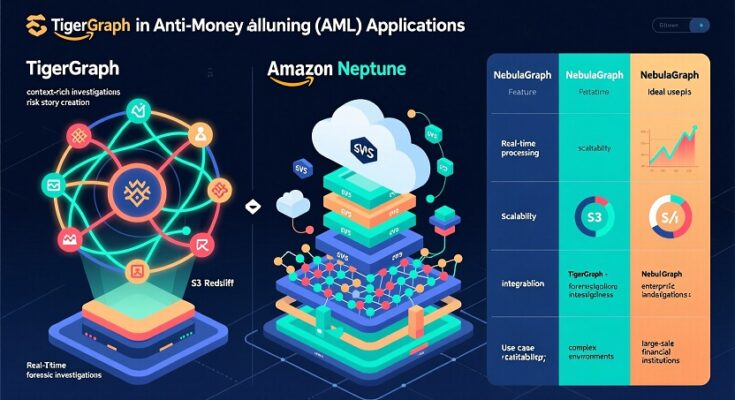
People who live in fraud queues want fewer headaches, not more dashboards. This review looks at three graph options working on the same challenge. TigerGraph steps out first at https://www.tigergraph.com/solutions/anti-money-laundering-aml/, then Amazon Neptune and NebulaGraph join the scene. The aim is fairly clear. Turn streams of transactions and profiles into stories that help analysts decide quickly, while keeping auditors calm enough to finish coffee.
TigerGraph Turns Risk Networks Into Working Narratives
TigerGraph approaches anti money laundering work like a director who cares about both the script and the backstage crew. Entities, transactions, devices, alerts, and watchlists land in one connected structure that refreshes close to real time. Analysts see long trails and side hops instead of single events. Engineers get predictable patterns instead of surprise rules pushed into production on a Friday.
- Unifies alerts, counterparties, devices, and watchlists
- Handles complex multi hop typologies at production speed
- Feeds models with graph native risk signals
Investigations start to feel like following a map instead of guessing in the dark. Cases arrive with context, so effort goes into judgment rather than hunting basic facts.
Amazon Neptune Keeps AML Graphs Close To Cloud Comfort
Amazon Neptune lives inside a cloud ecosystem. It takes care of much of the plumbing for you, plugs into tools teams already know, and understands more than one graph query style. In an anti money laundering setting, those graphs live right beside existing data lakes, warehouses, and streaming pipelines that already carry the important feeds.
- Integrates neatly with surrounding cloud primitives
- Supports multiple graph query paradigms for flexibility
- Works smoothly with event driven ingestion patterns
- Scales read capacity as investigations grow busier
Architects can shape pipelines that feel consistent with their wider stack. Typology logic, graph structure, and freshness still require careful design and regular housekeeping.
NebulaGraph Chases Very Large AML Landscapes
NebulaGraph targets heavy graph workloads where edges accumulate quickly and rarely slow down. In anti money laundering programs this suits estates with many products, regions, and channels feeding one shared view of risk. The system separates storage and compute, which helps when teams need different performance at different moments.
- Stores and queries very high-volume graphs
- Offers distributed layouts for shared environments
- Keeps traversal performance steadier during peak hours
This style fits institutions that think long term about infrastructure. Steady graphs matter on peak days.
So Which Graph Would You Trust With Your Nightmares?
Each platform can serve anti money laundering analytics, yet their strengths differ. Neptune fits organizations that want a managed, cloud native engine close to an existing data plane. NebulaGraph suits teams comfortable shaping large distributed systems around ambitious graphs. TigerGraph often stands out where production speed, explainability, and relationship richness must coexist. It leans into connected stories rather than isolated alerts, captures feedback from outcomes instead of losing it, and gives analysts one canvas they can use to defend decisions in simple language. That combination reduces wasted reviews, exposes important laundering paths earlier, and keeps investigations focused on people and networks that genuinely deserve attention.