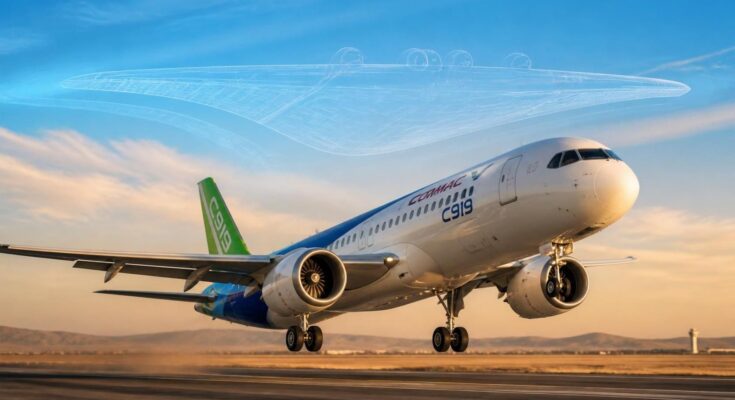
The year 2026 is shaping up to be a pivotal one for China’s aviation industry, marking its transition from a follower to a formidable innovator on the world stage. From the skies above Earth to the vastness of space, China is demonstrating rapid progress across commercial aviation, green technology, space exploration, and low-altitude economy.
Commercial Aviation Goes Global and Diversifies
The most significant headline is the international expansion of China’s domestically produced C919 jetliner. In a landmark move, Air China launched a daily round-trip service between Beijing and Ulaanbaatar, Mongolia, on August 12, marking the C919’s entry into a regular international commercial route integrated into the global ticketing system . This milestone was achieved not by waiting for the lengthy U.S. FAA or European EASA certification process but through a bilateral airworthiness agreement with Mongolia. This strategy, leveraging Belt and Road cooperation, could allow the C919 to expand to Southeast Asia and Central Asia, establishing regional parts and maintenance depots . The message is clear: China’s aviation ambitions are not confined by Western certification timelines.
Simultaneously, the C919 program is evolving into a full aircraft family. The high-altitude variant of the C919, designed for the demanding conditions of airports at 2,438 meters or above, completed its maiden test flight in July . With a shortened fuselage and seating for 140-160 passengers, this variant is specifically aimed at the plateau routes of Western China and potentially mountainous markets in Central and South Asia . Xizang Airlines has already finalized an order for 40 of these aircraft, cementing a strong launch customer for this specialized model .
The vision extends even further into the future. Chinese scientists have published a peer-reviewed paper detailing a concept for an 800-seat “flying wing” passenger aircraft, a design that could fundamentally redefine commercial aviation . While there is no timeline for development yet, the concept demonstrates the audacious thinking emerging from China’s research and development sector.
Green and Sustainable Aviation Fuel
China is tackling the challenge of aviation’s carbon footprint with a world-first technology. In August, a “thousand-ton class CO2 hydrogenation to sustainable aviation fuel” (CO2AF™) technology passed a major milestone evaluation . After a 72-hour full-load test run, the pilot plant demonstrated a 97.37% CO2 conversion rate and achieved a 92.37% selectivity for aviation fuel components . The technology was hailed as a “world-first” with “internationally advanced” overall performance . This breakthrough provides a tangible pathway to meet global mandates for sustainable aviation fuel, using CO2 and green hydrogen as feedstocks—a game-changer for the industry’s decarbonization efforts.
A Giant Leap in Space Communications
Beyond Earth’s atmosphere, China has achieved a monumental breakthrough in deep-space communications. For the first time, China has successfully conducted a two-way, high-speed laser communication link between Earth and lunar orbit, covering a distance of over 400,000 kilometers . This technology dramatically increases data transmission speeds. An 8K ultra-high-definition image of the moon, which would take 4-5 minutes to download using traditional microwave links, can now be transmitted in just 12 seconds . This capability is crucial for future lunar exploration, deep-space missions, and scientific research, solving the “alignment, signal, and speed” challenges that have long plagued deep-space laser communication .
Innovations in Propulsion and New Engines
The industrial and academic sectors are also pushing boundaries in propulsion technology. In a groundbreaking test, researchers from Beihang University and a commercial space firm successfully launched an “aluminum-ice” sounding rocket in August . This marks Asia’s first successful flight test of a rocket engine using aluminum powder and water ice as fuel, and it sets a new world altitude record for this specific type of engine . This is a critical step forward in the concept of in-situ resource utilization (ISRU) for future lunar bases, where water and aluminum could be sourced directly from the moon.
Closer to Earth, the first domestically developed engine specifically for electric vertical takeoff and landing (eVTOL) aircraft has rolled off the production line . The AEE25 engine boasts a torque density of 40 Nm/kg, the highest among China’s publicly disclosed 200-kW-class aviation electric engines, making it lighter and more efficient . This achievement will power China’s burgeoning low-altitude economy and urban air mobility sector.
Finally, the country is streamlining its space launch capabilities. The “Lijian” rocket family has achieved two major “firsts”: the Lijian-1 is preparing for its inaugural sea launch, while the more powerful Lijian-2 is set for its first mission to launch 18 satellites for a low-orbit constellation . These developments underscore China’s growing capability for rapid and flexible satellite deployment, a cornerstone of its expanding space economy.