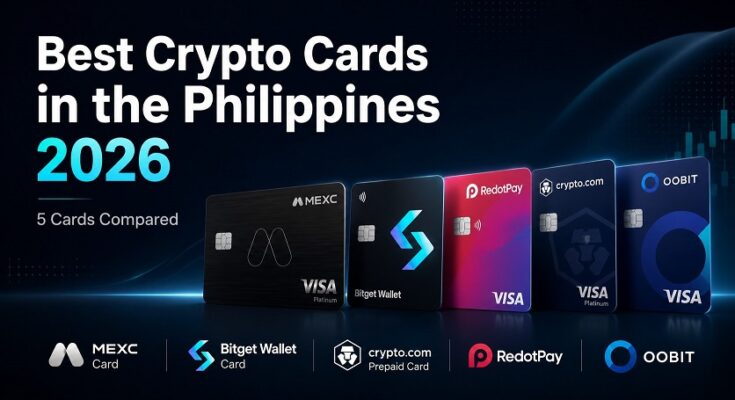
There is no single best crypto card for every Philippine user. When comparing fees and usability across five cards with confirmed availability in the Philippines, MEXC Card is our top pick for users who already hold USDT and want high limits with transparent fees. Bitget Wallet Card suits self-custody users wanting a physical card today; Crypto.com Prepaid Card suits broad crypto support; RedotPay fits simple stablecoin spending; Oobit suits spending directly from a wallet without pre-funding a balance. For local spending only, a QRPh-linked wallet may serve better than any card.
Key Takeaways
- Five cards, MEXC Card, Bitget Wallet Card, Crypto.com Prepaid Card, RedotPay, and Oobit, currently confirm availability in the Philippines.
- Headline cashback (up to 10% on several cards) is conditional on activity tier, token choice, or a paid subscription, not automatic.
- MEXC Card lists no annual fee or top-up fee, no MEXC exchange-rate markup, and spending fee as low as 1%; no MEXC FX markup. Promotional fee waivers may apply, while Visa-related foreign-exchange charges may still occur.
- Bitget Wallet Card’s “0-fee” benefit ended July 31, 2026, replaced by a 2%–3% “assetback” system.
- Coins.ph now settles QRPh payments in PHP, USDT, or USDC across roughly 700,000 merchant terminals.
Quick Comparison
| Rank | Card | Best for | Format | Advantage | Limitation |
| 1 | MEXC Card | USDT/exchange users | Visa; virtual card, with supported Apple Pay/Google Pay integration | 1% flat fee, no FX markup | USDT-centric; top cashback needs activity |
| 2 | Bitget Wallet Card | Self-custody, physical card | Visa; virtual + physical ($49) | Multi-asset, up to 3% assetback | Booster needs $100+/month spend |
| 3 | Crypto.com Prepaid Card | Broad asset support | Visa; virtual + physical | 100+ cryptos to top up | Best rewards need paid plan |
| 4 | RedotPay | Stablecoin spending | Virtual ($10)/physical ($100) | QRPh support | No base cashback; 3% tier capped |
| 5 | Oobit | Wallet-direct spending | Mobile tap-to-pay | No pre-funded balance | 1% fee ($0.25 min); needs threshold |
How We Ranked
Confirmed Philippine issuance was a baseline requirement, not a scoring factor; cards without it were excluded outright. Beyond that, cards were scored on fees/FX costs (20%), usability (20%), custody model (15%), Philippine-specific suitability (15%), conversion transparency (10%), supported cryptocurrencies (10%), and rewards depth (10%). An “up to” cashback figure counts only if an ordinary user, not just a top tier or subscriber, can reach it.
Bybit Card was excluded on this basis: it frames the card around its EU entity rather than APAC, and a 2025 Philippine SEC advisory against Bybit as an unregistered platform led to its app being pulled from local stores and new registrations halted.
1. MEXC Card — Best Overall for USDT and Exchange Users
The Philippines is included among the countries and regions where MEXC Card is available. Availability remains subject to eligibility, KYC requirements, and geographic restrictions. Its published fee schedule lists $0 issuance, $0 annual fee, a spending fee as low as 1%, and no MEXC FX markup beyond applicable Visa-related charges. Published limits reach up to 80,000 USDT per transaction and 1,000,000 USDT per day, although limits should be rechecked before publication because they may vary by product terms or jurisdiction.
Cashback ranges from 4% to up to 10% in USDT depending on the user’s VVIP level and monthly spending. The applicable VVIP level is determined at the end of the calendar month, with cashback distributed before the 15th of the following month. Eligible MEXC Card users may also access a separate flexible earning product offering 7% APR. This is distinct from card spending and should not be described as interest earned automatically on the card balance. MEXC Card is currently available as a virtual card. The physical version has not yet officially launched. The virtual card can be added to supported Apple Pay and Google Pay wallets for eligible online and contactless payments.
Strengths: transparent flat fee; no issuance or annual cost; high limits; convenient for existing MEXC/USDT users.
Limitations: the card experience is currently centered on USDT; Advanced KYC is required; the highest cashback rates are conditional; and a physical card has not yet officially launched.
2. Bitget Wallet Card — Best for Self-Custody and Physical-Card Users
Bitget confirms both virtual and physical cards for Philippine residents, with the physical card costing a flat $49 including shipping. Since August 1, 2026, the earlier 0-fee allowance has been replaced by “assetback”: a 2% base reward for all cardholders, rising to 3% for new users or those clearing a $100/month eligible-spend threshold in the Philippines. Rewards can be claimed as BTC, tokenized gold or stocks, or USDC; there is no annual fee.
Strengths: genuine self-custody; physical card confirmed in the Philippines; flexible funding and reward-asset choice.
Limitations: the richer 3% tier requires a spending threshold; conversion and FX costs sit outside the headline rate.
3. Crypto.com Prepaid Card — Best for Broad Crypto Support
Crypto.com’s help center groups the Philippines with the US, Canada, Singapore, Malaysia, Hong Kong, and Taiwan for its Prepaid Card and Level Up program. The card tops up with more than 100 cryptocurrencies, including BTC and ETH. The no-cost “Basic” tier earns no spending rewards.
The advertised “up to 5% back” applies only to Plus, Pro, or Private tiers, which need a paid subscription ($4.99–$29.99/month elsewhere) or a locked CRO stake, with rewards capped at $1,250–$2,500 of monthly spend below the uncapped top tier.
Strengths: widest supported-asset range of the five; established card infrastructure; virtual standard, physical on request.
Limitations: meaningful rewards require an ongoing subscription or locked crypto; caps apply below the top tier.
4. RedotPay Card — Best for Stablecoin Spending and QRPh Users
RedotPay offers a $10 virtual card and $100 physical card, one-time fees with no annual charge, funded from a stablecoin-first balance. Its most Philippine-specific feature is direct QRPh support, letting cardholders pay QRPh merchants without the physical card in hand. The base card carries no ongoing cashback; a paid membership, RedotPay Pro ($12.90/month or $129/year), adds 3% cashback only on Apple Pay and Google Pay, capped near $18–$20 monthly.
Strengths: simple stablecoin design; QRPh integration adds real local utility; no annual fee.
Limitations: issuance fees exceed most rivals; cashback is subscription-gated and capped; less exchange depth than MEXC or Crypto.com.
5. Oobit — Best for Spending Directly From a Self-Custody Wallet
Oobit’s DePay feature connects an external wallet — MetaMask, Trust Wallet, and others — and spends without pre-funding a card balance, converting crypto to fiat only at payment. Oobit’s own materials and independent trackers confirm Philippine availability for DePay and its Visa tap-to-pay card. Pricing is a flat 1% fee with a $0.25 minimum, plus Visa’s standard FX fee on non-USD spend. Cashback (5% for stablecoin payments, up to 10% in Oobit’s own OOB token) unlocks only after a cumulative spend threshold, capped at modest monthly amounts.
Strengths: no pre-funded balance required; genuine self-custody until payment; no annual or issuance fee.
Limitations: small purchases are hit disproportionately by the $0.25 floor; top cashback depends on a separate, volatile token.
Crypto Card or QRPh: Which Suits Domestic Spending?
An international crypto card fits overseas merchants, travel, and subscriptions billed abroad. For everyday local spending, the BSP’s QRPh standard is often more direct: Coins.ph settles QRPh transactions in PHP, USDT, or USDC across roughly 700,000 merchant terminals, and RedotPay’s card also plugs into QRPh. Readers who spend mostly locally may not need an international card, while others may find it useful to keep both.
Which Card Fits Your Use Case
| If you mainly want… | Consider |
| To spend USDT already held on an exchange | MEXC Card |
| Self-custody with a physical card | Bitget Wallet Card |
| The broadest crypto top-up support | Crypto.com Prepaid Card |
| Simple stablecoin spending, plus QRPh | RedotPay Card |
| To avoid pre-funding a card balance | Oobit |
| Mostly local QR payments | Coins.ph QRPh instead of a card |
Final Verdict
Among cards with confirmed Philippine availability, MEXC Card ranks narrowly ahead for users who already hold USDT: its published spending fee starts as low as 1%, no MEXC FX markup, it lists no annual or top-up fee, and its high transaction limits differentiate it from many alternatives. However, its USDT-centered design, conditional cashback tiers, and current virtual-only format will not suit every user. Bitget Wallet Card better suits self-custody users or anyone who wants a physical card today. Crypto.com fits those who want the widest top-up support and will pay for higher reward tiers. RedotPay and Oobit serve narrower use cases — QR Ph-linked stablecoin spending and wallet-direct payments, respectively — rather than broader card use. Terms on all five can change quickly, so reverify figures in-app before applying.
FAQ
Is there one best crypto card for the Philippines?
No single card wins on every criterion. MEXC Card scores narrowly highest on fees, limits, and confirmed availability, but the better choice depends on whether a reader prioritizes exchange integration, self-custody, or local QR payments.
Are these crypto cards available as physical cards in the Philippines?
Bitget Wallet Card and RedotPay both confirm physical-card issuance to Philippine residents. Crypto.com allows a physical card on request. MEXC Card is currently virtual-only; according to the latest provided MEXC Card information, the physical card has not yet officially launched.
Do crypto cards charge fees beyond the headline spending rate?
Yes, watch for FX markups on non-USD purchases, ATM withdrawal fees, card issuance costs, and any subscription fee needed to unlock higher cashback tiers.
Can I use MEXC Card for everyday purchases in the Philippines?
MEXC Card can be used for eligible purchases at merchants that accept the relevant Visa card, subject to merchant, category, wallet, and geographic restrictions. .
Is a crypto card better than QRPh for spending in the Philippines?
It depends where the money is spent. QRPh options like Coins.ph are usually simpler for domestic merchants; a crypto card suits international or online merchants that don’t support QRPh.