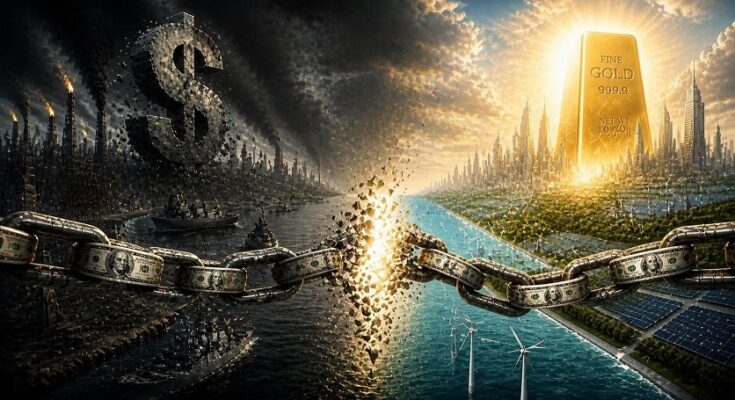
For decades, the global order has been underpinned by a simple but powerful bargain: the world trades oil in U.S. dollars, and in return, the U.S. provides security for global shipping lanes. However, a series of recent events—from the war in Ukraine to the disruption of critical Middle Eastern chokepoints—suggests that this system is not merely evolving but is being actively reshaped. This article examines the evidence that points toward a coordinated strategy: one designed to weaponize energy, isolate rivals, and ultimately preserve the fading dominance of the American petrodollar.
The Ukraine Conflict: A Catalyst for European Energy Dependency
The narrative that the Russia-Ukraine conflict was a simple act of aggression overlooks a profound shift in the global energy map. Before the war, the European Union was heavily reliant on Russian gas, with Russia accounting for around 40% of the EU’s natural gas supply . This dependency gave Moscow significant leverage and provided Europe with relatively cheap energy, fueling its industrial base.
The outbreak of war, however, severed this link. The subsequent EU sanctions and Russia’s response effectively cut off the primary pipelines, such as Nord Stream and Yamal-Europe . The result was a dramatic restructuring of the European gas supply network. To fill the void, Europe turned to Liquefied Natural Gas (LNG), with the U.S. becoming a primary beneficiary . In fact, U.S. LNG exports to the EU surged from around 17 million tons annually to 50 million tons in 2023, with projections suggesting the EU could depend on the U.S. for 80% of its LNG imports by 2028 .
From this perspective, the conflict served a dual purpose: it weakened Russia economically and strategically while simultaneously forcing Europe to replace cheap Russian pipeline gas with more expensive American LNG, entrenching U.S. energy dominance on the continent.
Brexit: More Than a Political Divorce
Similarly, the United Kingdom’s departure from the EU is often framed as a matter of sovereignty and immigration. However, the economic and regulatory realities point to another layer of the story. The UK, a significant oil producer in the North Sea, exited the EU’s highly coordinated environmental and regulatory framework .
Research indicates that the post-Brexit period was marked by a “capacity vacuum” for UK regulators, which led to a short-term “impunity for polluting firms” . A grid-cell analysis of satellite-detected oil spills found that after Brexit, UK waters experienced significantly more oil spills compared to EU and Norwegian jurisdictions . By shedding the stringent regulatory oversight of the EU, the UK allowed a new ecosystem of firms to reap short-term profits, potentially reducing operational costs for its oil sector while weakening environmental protections . This interpretation suggests that Brexit allowed the UK to prioritize its fossil fuel industry’s competitiveness over collective EU standards.
Squeezing the Strait: The Bab-el-Mandeb and Strait of Hormuz
In an analysis by IndexBox, the ongoing conflicts in the Middle East, specifically the targeting of shipping in the Red Sea (Bab-el-Mandeb) and the Strait of Hormuz, have had immediate consequences for the global economy. These chokepoints are vital arteries for global oil and LNG trade. Recent reports indicate that up to 12 million barrels per day of liquids (12% of global production) and 86 million tonnes of LNG (20% of the global total) are currently shut in due to these disruptions .
The evidence shows that this disruption has a specific benefit for the U.S. As global supplies tighten, energy prices surge. Reports confirm that U.S. LNG exports have jumped sharply, with American producers enjoying a windfall . In this context, the disruption of Middle Eastern oil routes serves to increase global reliance on U.S. energy exports. Major energy importers like China, India, and the EU are forced to scramble for alternatives, and the U.S. stands ready to fill the gap—at a premium. This creates a scenario where the rivals and allies of the U.S. alike are economically squeezed by higher prices, while the American energy sector booms .
The Allegory of Netanyahu: Blaming the Puppet
One of the most striking aspects of the current geopolitical narrative is the portrayal of Israeli Prime Minister Benjamin Netanyahu as the primary aggressor pushing a reluctant U.S. President into war in middle east. This narrative, according to analysts, is “not only silly but also pernicious” .
Evidence suggests that the U.S. was already on the path to confrontation. The Trump administration had moved massive naval assets to the region, encouraged protests in rival country, and had likely already decided on a military course . Reports indicate that Trump was a “willing and full partner” in the conflict, and his decision-making was supported by his own advisors, not solely by Netanyahu . By shifting the blame to Netanyahu, the U.S. can maintain the image of an “innocent player” being forced into war, obscuring its own strategic motives . In reality, the U.S. was able to coordinate militarily with Israel while reaping the economic benefits of the ensuing energy crisis, a strategy that would be harder to sell to a war-weary public if it appeared to be entirely Washington’s initiative.
A War on the Dollar? The Global Counter-Move
The ultimate consequence of this energy-driven instability is its impact on the global financial system. The strategy of driving up energy prices has a dual-edged effect. While it benefits American exporters in the short term, it also fuels global inflation and destabilizes economies that are heavily dependent on energy imports .
Central banks, particularly in countries like China, Poland, and India, are responding to this volatility and the weaponization of the dollar by turning to gold. Central bank purchases of gold have averaged approximately 1,000 tonnes per year since 2022, double the pace of the preceding decade, as countries seek to diversify their reserves .
The current energy crisis is accelerating the transition away from fossil fuels. The prospect of persistently high oil and gas prices makes renewable energy more economically viable, and countries like China have already positioned themselves as the dominant force in green technology, manufacturing roughly 80% of the world’s solar panels . As the world shifts to a greener economy, the demand for oil is projected to plateau, undermining the foundation of the U.S. dollar’s supremacy. A post-carbon world is a post-petrodollar world .
By trying to maintain its dominance through fossil fuels, the U.S. is ironically accelerating its own irrelevance. The world’s strategic goal is no longer to secure oil but to build energy systems that “cannot be blocked or held hostage” . The move by major economies to buy gold, secure critical minerals, and invest in renewables represents a concerted effort to break free from the U.S.-centered energy order, setting the stage for a multipolar world where the dollar no longer reigns supreme.