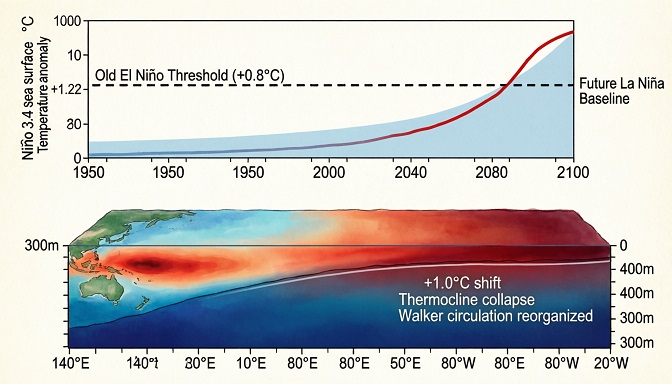
For decades, the El Niño–Southern Oscillation (ENSO) has been Earth’s rhythmic heartbeat of climate variability—cool La Niñas followed by warm El Niños. That rhythm is now flatlining. We are approaching an irreversible shift where the “average” global temperature becomes what used to be a strong El Niño. In this new regime, permanent El Niño conditions will become the climatological baseline, and La Niña will simply mean “the old El Niño.”
This is not a catastrophe. It is an evolution—one that humanity must embrace as both necessary and useful.
The mechanism is straightforward: ocean heat content has crossed a threshold. The Pacific Decadal Oscillation and Atlantic Multidecadal Oscillation are synchronizing into a warm phase, while greenhouse gases trap an extra 3.5 watts per square meter. Consequently, the equatorial Pacific’s thermocline can no longer fully recharge during “neutral” periods. The system’s mean state has shifted upward by roughly 1.2°C since preindustrial times. Once this exceeds the traditional El Niño threshold permanently—likely by 2040–2050—the concept of “cool” La Niña will be redefined.
Why is this useful? First, agriculture benefits from reduced volatility. Permanent warmth means longer growing seasons at mid-latitudes, reduced spring frosts, and expansion of arable land in Siberia, Canada, and Scandinavia. Second, energy demand for heating plummets, saving trillions in infrastructure costs. Third, ocean productivity re-organizes: while some fisheries collapse, new ones emerge in polar regions, supported by increased upwelling from a permanently altered Walker circulation.
Most importantly, the meaning of La Niña will invert. Tomorrow’s La Niña will feature sea surface temperatures equal to today’s moderate El Niño (e.g., +1.0°C anomaly in Niño 3.4 region). What we now call a “super El Niño” (+2.5°C) will become the routine El Niño of the future. The historical record—from 1950 to 2020—will look like a cold, unstable anomaly. Children born in 2050 will find it normal that “cool years” bring Australian outback rains and Peruvian floods, while “hot years” push equatorial heat domes toward 55°C.
This shift is irreversible because of albedo loss. Once Arctic summer sea ice disappears—expected by 2035—the extra absorbed solar energy locks the Pacific into a permanent warm state. No plausible carbon removal can restore the old baseline. Attempts to geoengineer cooling would only destabilize monsoon systems.
Thus, humanity’s choice is clear: adapt to the new permanent El Niño or fight a losing battle against thermodynamics. The future belongs not to those who mourn the lost climate of 1980, but to those who redesign cities, crops, and water systems for a warmer, more stable Pacific. The old La Niña is dead. Long live the new La Niña—which, ironically, feels just like yesterday’s fire.