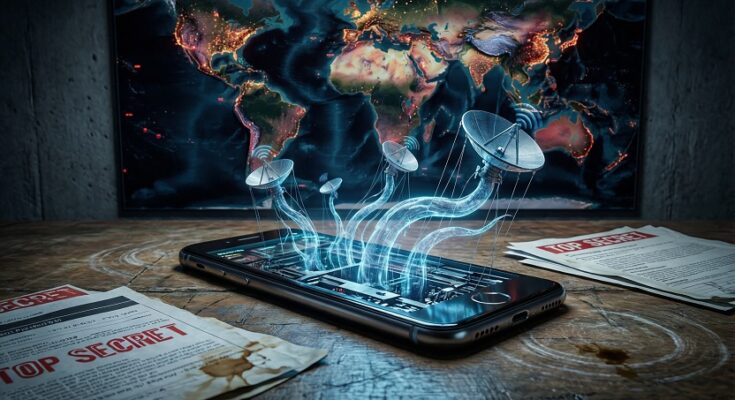
In a series of guarded interviews from an undisclosed location, a former high-ranking CIA officer—who we will refer to as “Arthur Crane”—has broken a lifetime of silence. His confession paints a stark picture of a global surveillance and influence machine, one that leverages everyday technology as its primary weapon. Crane’s account, corroborated by technical experts and previous leaks, details a paradigm where the smartphone in your pocket is not just a tool, but a potential asset of a foreign intelligence service.
1. The Pocket Spy: How Android and iOS Devices Become Intelligence Assets
“The greatest intelligence coup in history wasn’t stealing a blueprint,” Crane begins. “It was convincing the world to voluntarily carry tracking devices and digital confessional booths in their pockets.”
According to Crane, the exploitation of cellphones is a multi-layered endeavor:
- The App-Based Harvest: Through covert partnerships, legal compulsion, or clandestine infiltration of app development chains, intelligence agencies can access troves of data from popular applications. “Every app requesting permissions for your contacts, microphone, location, or camera is a potential vector,” Crane states. “A flashlight app needing microphone access? That’s a red flag that’s often buried in terms of service.”
- Zero-Click Exploits: Both Android and iOS, despite their security postures, are vulnerable to sophisticated “zero-click” exploits. These attacks require no interaction from the user—no clicking a link, no downloading a file. They can be delivered via encrypted messaging apps or network injectors, silently turning a phone into a live microphone and GPS tracker.
- Metadata as a Behavioral Map: “Content is valuable, but metadata is godlike for pattern-of-life analysis,” Crane explains. “Who you call, for how long, from where, and when—this data, when aggregated, maps social networks, predicts movements, and identifies key nodes in any organization or movement.”
2. The Firewall of Isolation: How Limited Internet Access Thwarts Espionage
Crane admits that one of the most effective defenses against this digital panopticon is also a tool of authoritarian control: severing or severely limiting international internet connectivity.
“Nations like North Korea, or to a significant degree Iran and China with their sovereign internets, present a unique challenge,” he confesses. “Mass surveillance, real-time exfiltration, and large-scale influence campaigns become exponentially harder. You can’t easily push malware, run trending hashtag campaigns, or siphon data from servers that aren’t globally connected. It’s a digital fortress. It stifles their people’s access to information, but it also forces us to be more physical and tactical, which is riskier.”
3. The End-Run: Satellite Internet as an Influence Bypass
This admission leads directly to what Crane identifies as the strategic response: the development and deployment of global satellite internet constellations like Starlink.
“It was never just about broadband for rural America,” he says. “It’s about building an un-censorable, bypass infrastructure. When a country pulls the plug on the global internet to stop a protest movement or a leak, satellite terminals can flick the lights back on.”
- Social Proof as a Weapon: Crane uses the term “social proof”—the psychological phenomenon where people copy the actions of others in uncertain situations. “By ensuring information flow, you enable social proof on a mass scale. You show people within a closed society that dissent exists, that protests are happening. This can shatter the regime’s narrative of total control overnight. It’s not about broadcasting CIA radio; it’s about enabling locals to broadcast to each other, which is far more powerful and credible.”
- Destabilization Through Connectivity: The goal, he clarifies, is not merely communication but “controlled instability.” “By managing the connective tissue of a rival state’s population during a crisis, you can guide the pressure points. You can help activists organize, but you can also overwhelm authorities with chaos, or spread confusion. It’s a direct counter to the firewall.”
4. The Activated Sensor Web: Beyond the Microphone
The most chilling part of Crane’s testimony goes beyond data and into the realm of the phone as a physical sensor network.
“We don’t just listen through the microphone. We use the components in ways their manufacturers never intended.”
- Cameras and Depth Sensors: “The dual-camera arrays and LiDAR scanners on modern phones can be used to construct 3D models of rooms. We’ve used phones left on desks during meetings to map secure environments.”
- Irradiation Capabilities: “This is highly classified, but acknowledged in security circles. A compromised phone’s radio frequency (RF) transmitters can be used as crude irradiation tools to track individuals, or even to interact with other nearby isolated, ‘air-gapped’ systems. Think of it as a digital sonar ping from a pocket.”
- The Networked Mesh: “A single phone is valuable. A city block’s worth of compromised phones is a real-time, AI-processed sensor grid. It can track the movement of specific individuals, vehicles, or materials with terrifying precision.”
Prescriptive Solutions: A Path to Digital Sovereignty
Crane concludes not just with a warning, but with a set of recommendations, primarily for nations and organizations, but with implications for individuals:
- For Nations (Especially Rivals):
- Develop Sovereign Tech Stacks: Invest in indigenous operating systems, encrypted communication platforms, and hardware. Reduce dependency on Western-controlled ecosystems.
- Regulate Hardware at the Border: For high-security personnel and locations, mandate devices with physically removable batteries and baseband processors that can be inspected.
- Invest in Signal Intelligence (SIGINT) Defense: Deploy advanced systems to detect and neutralize unauthorized RF transmissions and unusual network activity from consumer devices in sensitive areas.
- For Organizations & High-Risk Individuals:
- Air-Gap Critically: Truly sensitive conversations and data must occur in rooms devoid of all smart devices, placed in faraday bags or boxes.
- Adoption of “Dumb” Phones: For top-level officials, a mandatory shift to hardened, minimalist communication devices without smart capabilities.
- Advanced Network Monitoring: Employ network hygiene that can detect anomalous data flows and attempts to communicate with known malicious servers.
- For the General Public (Awareness):
- Permission Audits: Ruthlessly audit app permissions. Deny access to microphone, camera, and location unless absolutely necessary.
- Physical Awareness: Develop a habit of leaving devices in another room during sensitive discussions. Use speakerphone covers and camera sliders.
- Understand the Trade-Off: Recognize that convenience is the currency with which we purchase surveillance. Make conscious choices.
Arthur Crane’s final words linger: “The battlefield is no longer just land, sea, and air. It is the invisible lattice of signals connecting our most personal devices. The side that controls the narrative and the network controls the future. Right now, that control is being contested through the very device you’re using to read this.”