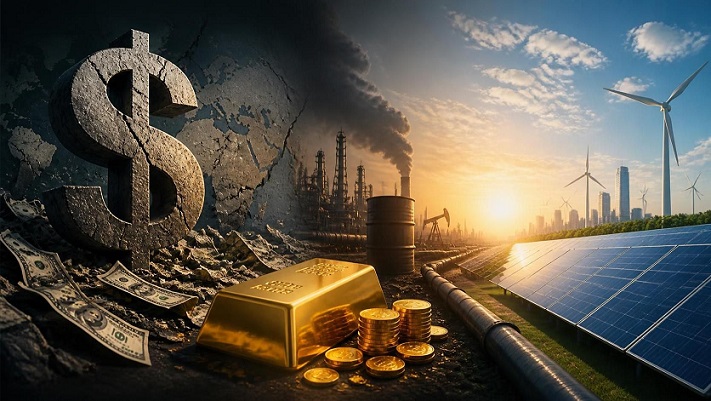
For over half a century, the world has been trapped in a carefully engineered financial architecture. The petrodollar system, born in 1974 when Saudi Arabia agreed to price oil exclusively in U.S. dollars in exchange for American security guarantees, created a global demand for greenbacks that had nothing to do with the underlying strength of the U.S. economy. It was, and remains, a mechanism of coercion disguised as commerce.
But the evidence is now overwhelming: this system is not merely under strain—it is being actively dismantled. And the final nail in its coffin may come not from the gold-buying central banks of BRICS nations, but from a new and powerful alliance that has yet to formally declare itself: the Organization of the Petroleum Importing Countries (OPIC) .
The Missing Counterweight to OPEC
For decades, OPEC has functioned as a cartel of oil producers, coordinating supply cuts to manipulate prices. When OPEC reduces output, oil prices spike. When oil prices spike, global demand for dollars spikes—because oil is priced in dollars. This creates a vicious cycle: nations must hoard dollars to pay for energy, financing American debt and propping up the very currency that is being used to export inflation to their shores.
But what if the consumers of oil—the nations that actually buy the 100 million barrels per day that keep the global economy running—formed their own cartel? What if they collectively refused to play the game?
An Organization of the Petroleum Importing Countries (OPIC) —modeled on OPEC but representing the demand side of the equation—would be the single most disruptive force in the history of the global financial system. Here is how it would work, and why it would change everything.
1. Refusing to Buy at High Prices: Breaking the War-Price Cycle
The evidence presented in recent analyses is undeniable: Middle East conflicts are not merely geopolitical crises—they are staged financial operations designed to manipulate oil and gold prices. When tensions flare in the Strait of Hormuz or the Bab-el-Mandeb, oil prices surge while gold is simultaneously suppressed. As documented in recent ICDST reporting, oil prices have surged approximately 57%—from $71.23 to $111.54 per barrel—while gold fell from $5,294.40 to $4,651.50 per ounce during the same period.
The mechanism is brutally simple:
- Staged conflict → oil supply fears → price spike
- Rising oil prices → inflation concerns → expectations of higher Fed rates
- Higher rates → gold becomes less attractive → gold price suppressed
- Dollar demand → nations must buy dollars to pay for expensive oil → dollar strengthened
- U.S. benefits → American LNG exports surge, rivals are economically squeezed
A unified OPIC would break this cycle at its first link. If the world’s largest oil importers—China, India, Japan, South Korea, Germany, France, and dozens of others—collectively agreed to cap their purchase prices and refuse to buy above a predetermined threshold, the entire war-price mechanism would collapse. Oil producers would be forced to either accept lower prices or watch their revenue evaporate as OPIC members coordinate purchases from non-conflict sources, release strategic reserves, and accelerate the transition to alternatives.
The staged conflicts would no longer serve their purpose. The financial incentive to manufacture crises would disappear.
2. Switching to Renewable Energy: The Ultimate Weapon
The second pillar of OPIC’s strategy would be even more devastating to the petrodollar system: a coordinated, accelerated transition to renewable energy sources.
The logic is inescapable. The petrodollar system exists because the world needs oil, and oil is priced in dollars. If the world no longer needs oil—or needs dramatically less of it—the foundation of dollar hegemony crumbles. As the recent analysis correctly notes: “A post-carbon world is a post-petrodollar world.”
OPIC members would collectively commit to:
- Massive investment in solar, wind, and battery storage—China already manufactures roughly 80% of the world’s solar panels
- Coordinated research and development into next-generation energy technologies
- Phasing out internal combustion engines in favor of electric vehicles
- Building cross-border renewable energy grids that cannot be blockaded or held hostage
- Sharing technology and intellectual property among member states to accelerate adoption
The impact on oil demand would be swift and severe. The International Energy Agency has already projected that global oil demand will plateau by the early 2030s. An OPIC-led push could accelerate that timeline dramatically. Every barrel of oil that is not purchased is a dollar that is not needed. Every renewable megawatt installed is a nail in the petrodollar’s coffin.
3. Pricing Oil in Alternative Currencies
OPIC would also coordinate a shift away from dollar-denominated oil pricing. Member states would agree to:
- Settle oil trades in local currencies or a basket of currencies
- Use gold-backed settlement mechanisms like the BRICS “Unit”—backed by 40% physical gold and 60% member currencies
- Develop alternative payment systems outside the SWIFT network, such as the mBridge project
- Demand that oil producers accept payment in non-dollar currencies as a condition of access to OPIC markets
This would directly attack the “exorbitant privilege” that allows the United States to export its inflation globally. If oil is no longer priced in dollars, the global demand for dollars collapses. The Federal Reserve would lose its ability to force other nations to absorb the consequences of its monetary policy.
4. The Gold Connection: Restoring Sound Money
As the dollar’s grip weakens, gold will naturally reclaim its historical role as the ultimate store of value. This is already happening. By the end of 2025, the total value of gold held in central bank reserves officially surpassed the value of U.S. Treasury holdings for the first time in 30 years. Gold now accounts for 27% of total official global reserves, compared to U.S. Treasuries at 22%.
An OPIC-led transition would accelerate this trend dramatically. As oil demand falls and dollar demand collapses, central banks would accelerate their gold accumulation. The World Gold Council’s 2026 survey reveals that 45% of central banks plan to increase their gold reserves, and 74% of reserve managers expect the dollar’s share of global reserves to decrease over the next five years.
The United States cannot print gold. It cannot dump its gold reserves without undermining its own wealth and signaling desperation. It cannot print dollars to buy gold without accelerating dollar devaluation and essentially “killing the U.S. dollar by its own hand.” As Alan Greenspan himself noted, a gold standard is “not possible in a welfare state” because it would restrict the ability to run large deficits and wage expensive wars.
This is precisely why the shift to gold-backed settlement systems is so threatening to the current order—and why OPIC would be so effective.
5. Stopping the Wars: The Geopolitical Dividend
Perhaps the most profound consequence of an OPIC-led transition would be the end of the perpetual conflict cycle in the Middle East.
The recent analysis of Middle East conflicts reveals a disturbing pattern: staged crises are engineered to spike oil prices, drain dollar liquidity from rivals, and force nations to hold dollars rather than accumulate gold. The Ukraine conflict severed Europe’s reliance on cheap Russian gas, forcing it to replace it with more expensive American LNG—entrenching U.S. energy dominance on the continent. Disruptions at the Bab-el-Mandeb and the Strait of Hormuz have tightened global supplies and surged energy prices, benefiting American producers while economically squeezing both rivals and allies.
An OPIC that refuses to buy at high prices and aggressively transitions to renewables would remove the financial incentive for these conflicts. If wars no longer produce economic benefits for the instigators, they become strategically pointless. The military-industrial complex that profits from perpetual conflict would lose its raison d’être.
The allegory of Netanyahu as the “puppet” pushing a reluctant U.S. president into war is, as analysts note, “not only silly but also pernicious.” The reality is that the U.S. was a “willing and full partner” in these conflicts, driven by its own strategic motives. OPIC would remove those motives by making war economically counterproductive.
6. The OPIC Framework: A Blueprint for Action
For OPIC to succeed, it would need a clear organizational structure and a coordinated strategy. Here is a proposed framework:
Membership: Open to all oil-importing nations committed to the principles of fair pricing, energy transition, and monetary sovereignty. Founding members could include China, India, Japan, South Korea, Germany, France, Italy, Spain, Brazil, South Africa, and Indonesia.
Core Objectives:
- Establish a collective bargaining mechanism for oil purchases
- Set maximum acceptable price thresholds for oil imports
- Coordinate strategic petroleum reserve releases to counter price spikes
- Accelerate the transition to renewable energy through joint investment and technology sharing
- Promote alternative settlement mechanisms for oil trade
- Advocate for gold-backed monetary systems at international forums
Institutional Mechanisms:
- OPIC Secretariat: A permanent administrative body to coordinate policy
- Joint Strategic Reserve: A shared petroleum reserve to stabilize prices
- Renewable Energy Fund: A pooled investment vehicle for clean energy projects
- Settlement Clearing House: A platform for non-dollar oil transactions
- Gold Reserve Pool: A collective gold reserve to back member currencies
Tactical Approach:
- Phase 1 (Year 1): Formalize membership, establish institutions, and announce collective price caps
- Phase 2 (Years 2-3): Implement coordinated purchasing, release strategic reserves, and launch renewable energy projects
- Phase 3 (Years 4-5): Shift majority of oil trade to non-dollar currencies and gold-backed settlement
- Phase 4 (Years 5-10): Achieve significant reduction in oil dependence and cement gold’s role in the monetary system
7. The Inevitable Backlash—and Why It Will Fail
The United States and its allies will undoubtedly resist OPIC’s formation. They will use every tool at their disposal: diplomatic pressure, economic sanctions, military threats, and propaganda campaigns. They will accuse OPIC members of “aggression” and “undermining the global order.”
But these efforts will fail for a simple reason: the world is no longer willing to be held hostage.
The evidence is already overwhelming. Central banks are accumulating gold at a historic rate. Alternative payment systems are emerging. The BRICS bloc has launched a working prototype of a gold-backed trade currency. The petrodollar system is being dismantled piece by piece, and OPIC would be the final blow.
The United States is caught in a classic financial paradox: it needs the dollar to be strong to maintain its status, but its fiscal policies and geopolitical actions continuously undermine that strength. It cannot print gold. It cannot dump its gold reserves without signaling desperation. It cannot buy gold without destroying the dollar. Its primary financial superpower advantage—the printing press—is its greatest weakness in a world shifting back toward sound, unprintable assets.
8. A Multipolar World Built on Gold and Renewables
The formation of OPIC would accelerate the transition to a multipolar world where no single nation can dominate the global financial system. In this new world:
- Gold sits at the center of nearly all emerging monetary systems, providing a neutral, non-sovereign store of value
- Renewable energy powers economies that cannot be blockaded or held hostage
- Trade is conducted in a basket of currencies and gold-backed settlement assets
- Wars of economic coercion become strategically pointless
- Sovereignty is restored to nations that have long been subject to the whims of U.S. monetary policy
The shift toward gold is not a call to return to a classical “Gold Standard” with fixed price parities, but rather a move toward gold-backed settlement systems that provide stability and neutrality in a fragmenting world. By controlling a majority of global gold production and holding massive reserves, BRICS nations are already positioning gold as a “settlement asset” that holds no geopolitical allegiance.
OPIC would complete this transition by attacking the demand side of the petrodollar equation. If the world’s oil importers refuse to buy at high prices, switch to renewables, and demand alternative settlement mechanisms, the petrodollar system collapses. It is not a question of if—it is a question of when.
Conclusion: The Disciplinarian of Gold and the Power of Collective Action
Gold, by contrast to the dollar, is a strict disciplinarian. It cannot be printed, manipulated, or weaponized without consequences. The world is no longer content to be held hostage by the fiscal and monetary policies of a single nation.
The current energy crisis is accelerating the transition away from fossil fuels, and a post-carbon world is inherently a post-petrodollar world. The move by major economies to buy gold, secure critical minerals, and invest in renewables represents a concerted effort to break free from the U.S.-centered financial order.
OPIC would formalize this effort, giving it institutional weight and collective bargaining power. It would transform scattered resistance into a coordinated offensive. It would make war economically counterproductive and peace economically profitable.
The evidence is clear: the era of the dollar’s undisputed dominance is ending. The world is preparing for a multipolar monetary reality where gold sits at the center of nearly all emerging systems. Countries that fail to diversify their reserves and adapt to this new reality risk being left vulnerable to the whims of U.S. monetary policy and geopolitical manipulation.
The transition to gold is not just a prudent hedge; it is becoming a necessary act of sovereignty. And OPIC—the Organization of the Petroleum Importing Countries—is the vehicle that will get us there.
The world is watching. The petrodollar is dying. And gold is waiting.