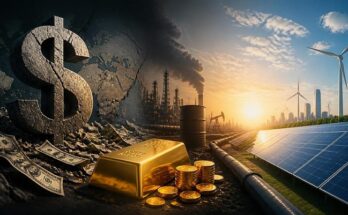
The world is watching Greenland with a new intensity. Its melting ice is revealing vast reserves of critical minerals and potential oil and gas deposits, sparking a modern-day scramble for resources . This rush is fueled by a dangerous irony: the very resource extraction enabled by climate change could trigger an even greater climatic catastrophe. The potential extraction of oil and gas from Greenland isn’t just a local environmental concern; it could become a primary driver of persistent, severe drought across Europe.
A Vicious Cycle Begins
The Arctic is warming nearly four times faster than the rest of the planet, a phenomenon known as Arctic amplification . This rapid warming is causing Greenland’s ice sheet to melt at an alarming rate, opening up new shipping routes and making previously inaccessible resources available for extraction . While the extraction of oil and natural gas in Greenland is currently banned for environmental reasons, the geopolitical and economic pressures are immense . However, the environmental cost of breaking this ban would be astronomical, not just in terms of emissions from the fuel itself, but in how it destabilizes the climate.
The Mechanism of a Drought: From Melting Ice to Blocking Highs
The connection between Arctic warming and European weather is a powerful, direct link. The warming of the Arctic is weakening the jet stream—the high-altitude river of air that normally drives weather systems across the Atlantic . A weaker jet stream becomes more “wavy” and tends to get stuck in place, leading to what scientists call atmospheric “blocking” . This means that the weather we experience—be it rain, sun, or snow—is more likely to persist for extended periods .
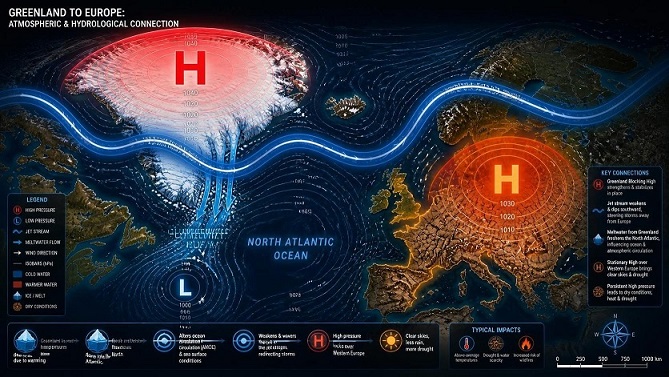
At the heart of this process is a phenomenon known as Greenland Blocking (GB) . This occurs when a persistent area of high pressure parks itself over Greenland . This blocking high acts like a shield, diverting the normal westerly flow of storms away from Europe. Research has shown that there has been a significant increase in Greenland Blocking, particularly during the summer, since around 1990 .
Here is where the proposed oil and gas extraction becomes the catalyst. Extracting and burning these fossil fuels would pump massive quantities of greenhouse gases into the atmosphere. This accelerates Arctic warming, which in turn accelerates the melt of the Greenland Ice Sheet.
The Catastrophic Connection: Meltwater, Highs, and Lows
The influx of cold, fresh meltwater from Greenland into the North Atlantic is a major disruptor. It can alter ocean currents and, critically, influence the formation of low-pressure systems in the region . This process creates a dangerous feedback loop:
- Arctic Warming & Melting: Fossil fuel extraction and use accelerate warming, increasing the melt of the Greenland ice sheet .
- Atmospheric Disruption: The melting ice and warming destabilize the atmosphere, strengthening the high-pressure systems that create Greenland Blocking .
- Pressure Shift: The persistence of these high-pressure systems over Greenland has a direct impact on Europe. As a high-pressure system anchors over Greenland, it tends to push low-pressure systems and their associated rainfall southward or around it. This leads to below-average air pressure over Greenland and the Mediterranean and above-average air pressure across northern Europe, a pattern strongly associated with dry and warm conditions .
- Severe European Drought: This persistent high pressure over Europe creates a “block” that deflects rain-bearing Atlantic storms, leading to prolonged heatwaves and severe drought .
The research is clear: when Greenland experiences these high-pressure blocking events, the weather over Europe becomes stagnant. The result is hotter, drier air and a lack of rainfall, which can cripple agriculture, deplete water resources, and devastate ecosystems . The warming and potential melting of the region associated with heightened warming from extraction activities would only exacerbate the persistence of these droughts by creating favorable conditions for this pressure pattern .
The Looming Crisis
The relentless pursuit of oil and gas in Greenland represents a profound miscalculation. It is not a solution to energy needs but a direct investment in a future of extreme climate volatility. The environmental and regulatory hurdles are already significant, as seen in the temporary halt of drilling by a U.S.-linked company in Greenland in August 2026 . However, the underlying pressure remains.
This is not a distant chain reaction. It is a documented and immediate mechanism already shaping our weather . By pursuing oil extraction in Greenland, we would be lighting a fuse that leads directly to an explosive shift in atmospheric circulation, ensuring that European summers become a battle against relentless, drought-inducing heat. The solution is not to drill deeper into a fragile Arctic but to accelerate the transition away from the very fossil fuels that have placed us on this precipice.