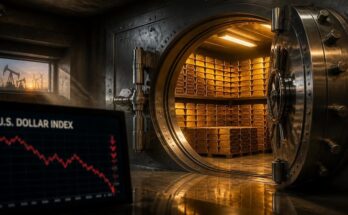
In the aftermath of the COVID-19 pandemic, the world witnessed a strange economic phenomenon. Supply chains snapped, factories went idle, and yet—oil prices skyrocketed. While many attributed this to “pent-up demand,” a deeper pattern emerged: a deliberate strategy of energy sabotage.
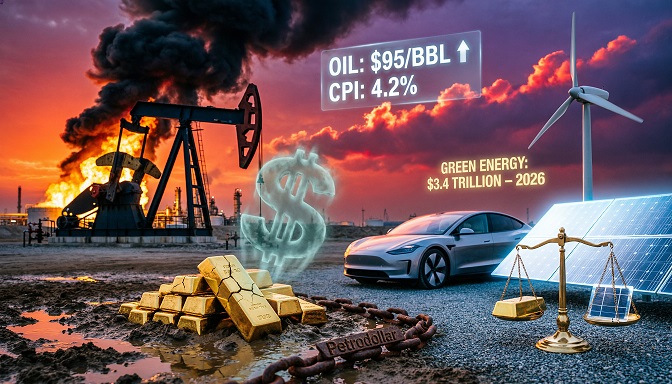
Whether through pipeline attacks, production cuts by OPEC+, or geopolitical blockades, the goal of making oil artificially expensive follows a three-step playbook. First, it exports crippling inflation to industrial importers (like the EU and Japan). Second, it kills the price of gold to prevent a dollar exodus. Third, it forces developing nations to bleed reserves. The only escape? A full-speed sprint into green energy.
Part 1: The Inflation Bomb (And Why China Survived)
When a refinery is sabotaged or a tanker is blocked, the price of crude oil does not just rise—it explodes. For oil-importing nations, this acts as a brutal regressive tax.
Consider the COVID-19 outbreak. Initially, demand collapsed, and oil futures went negative. But within 18 months, coordinated supply restrictions (disguised as “pandemic recovery”) sent oil to over $120 per barrel. The result? Importers like the European Union saw their trade deficits balloon and inflation hit double digits.
The Exception: China
China’s resilience to this sabotage was instructive. Because Beijing had locked in long-term supply contracts with Russia (outside the dollar system) and maintained strategic petroleum reserves, the inflation spike did not cripple its manufacturing base. The sabotage failed to stop China because it had built a firewall. This terrified the existing petrodollar system.
Part 2: The Gold Dump / Oil Pump Correlation
This is the most overlooked aspect of energy sabotage. When oil prices spike, gold dumps. Why?
Because the world runs on the Petrodollar. Oil is overwhelmingly priced in US dollars. When oil gets expensive, the world needs more dollars to buy the same amount of energy. This creates an artificial surge in demand for the US currency, strengthening the dollar against all other assets.
Simultaneously, to fight the resulting inflation, central banks in importing countries are forced to raise interest rates. Higher interest rates make holding non-yielding assets like gold painful. Consequently, investors sell gold, the price crashes, and the dollar soars.
The Sabotage Objective:
If countries cannot sell their oil in dollars, they must sell it for gold. But by orchestrating an “oil shock,” the saboteurs ensure that:
- Oil pumps (expensive and dollar-denominated).
- Gold dumps (cheap and falling).
This dynamic destroys any attempt by BRICS nations or others to replace the US dollar with a gold-backed trade currency. Every time you see oil spike, watch gold drop. That is not coincidence; that is design.
Part 3: The Trap for De-Dollarizers
For a country like India, Turkey, or Brazil, the calculus is cruel. To stop importing inflation, they want to buy oil in rubles, yuan, or gold. But when energy sabotage strikes:
- Their domestic currency collapses against the dollar.
- Their gold reserves lose value (in dollar terms).
- They are forced to sell even more of their national wealth to buy the same barrel of oil.
The sabotage is designed to keep the world perpetually borrowing dollars to buy oil, ensuring the US Treasury market remains the only “safe haven” in a storm.
Part 4: The Escape Hatch – Green Energy
How does a nation break this cycle of sabotage and inflation? The answer is radical but simple: Stop importing energy.
The only way to decouple from the oil-price-inflation machine is to switch to domestic green energy—solar, wind, nuclear, and grid-scale batteries.
Here is why green energy defeats the sabotage strategy:
- Price Inelasticity: Sun and wind have no OPEC. No one can sabotage the wind or impose a tariff on sunlight. Once a solar farm is built, the marginal cost of electricity is effectively zero. A tanker war in the Strait does not change the price of a kilowatt-hour from a domestic wind turbine.
- Killing the Petrodollar: If a country electrifies its vehicle fleet (EVs) and powers its grid with renewables, its demand for crude oil collapses. Without massive oil demand, the US dollar loses its primary global anchor. Countries can then freely trade in gold or a basket of commodities without fear of an oil-induced dollar shortage.
- Gold Revaluation: When energy is cheap and stable (via renewables), central banks do not need to hike interest rates. Low, stable interest rates allow gold to rise as a store of value. The “oil pump / gold dump” correlation breaks. When that correlation dies, the dollar hegemony dies with it.
Conclusion: The Sabotage Will Continue Until Diversification
The sabotage of oil infrastructure is not random terrorism. It is a macroeconomic lever designed to export inflation to the West, prevent the rise of a gold-backed trade system, and punish any nation attempting to leave the dollar sphere.
COVID-19 failed to stop China because China had stacked its reserves and locked in non-dollar supply lines. But for the rest of the world, the trap remains open.
The only permanent solution is to render oil geopolitically irrelevant. Switch to green energy. Build solar farms, nuclear plants, and battery storage. The day the world no longer needs to buy a single barrel of foreign oil is the day the sabotage ends—and gold will finally shine again without the shadow of the oil pump.